Why Route 53 Zone Transfers Are Hard — and How Teams Solve It
Understanding the limits of Amazon Route 53, common DNS synchronization problems, and practical ways to export and sync zones without disrupting DNS.
This article explains why Amazon Route 53 does not support standard DNS zone transfers, and how teams work around that limitation.
The Problem: Route 53 Is Not a Traditional DNS Primary#
Amazon Route 53 is a highly reliable, globally distributed DNS service. However, it is not designed to behave like a traditional authoritative DNS primary that supports standard zone transfer protocols such as AXFR and IXFR.
This becomes an issue when teams need to:
- Export DNS zones out of Route 53
- Maintain secondary DNS servers (for redundancy or compliance)
- Synchronize DNS across cloud and on‑prem environments
- Avoid long‑term DNS vendor lock‑in
In traditional DNS architectures, these problems are solved with zone transfers. With Route 53, those mechanisms do not exist in the same way.
Why Standard AXFR / IXFR Does Not Work with Route 53#
In classic DNS setups, an authoritative primary server exposes zones via AXFR (full transfers) or IXFR (incremental transfers). Secondary servers stay in sync automatically.
Route 53 does not operate this way:
- There is no native AXFR / IXFR endpoint
- Zones are managed via API, not zone files
- Route 53 cannot directly act as a primary for BIND or NSD secondaries
As a result, teams often fall back to brittle workflows:
- Manual exports
- Custom scripts polling the AWS API
- One‑off migrations that quickly fall out of sync
These approaches do not scale and are difficult to audit or automate.
Common Scenarios That Expose the Problem#
Exporting a Route 53 Hosted Zone#
Teams frequently need to export zones from Route 53 to:
- Migrate to another DNS provider
- Maintain an on‑prem copy of DNS
- Support disaster‑recovery or compliance requirements
Without standard zone transfers, this usually means API‑driven exports that must be rebuilt and re‑run for every change.
Maintaining Secondary DNS#
Many organizations want Route 53 as the source of truth while feeding secondary DNS servers such as BIND or NSD. Without AXFR/IXFR, keeping secondaries accurate requires custom glue code.
Multi‑Cloud DNS Synchronization#
Running workloads across AWS, Azure, and GCP often requires consistent authoritative DNS everywhere. Route 53 alone cannot propagate changes to other providers.
Avoiding Vendor Lock‑In#
Relying on a single provider without a clean exit strategy makes DNS migrations risky and expensive.
The Practical Solution: Introduce a DNS Translator#
Rather than forcing Route 53 to behave like something it is not, many teams introduce a DNS translation mechanism that:
- Treats Route 53 as a source of DNS state
- Monitors zones via API
- Synchronizes that state to systems that do support AXFR / IXFR
This approach preserves the strengths of Route 53 while restoring standard DNS workflows downstream.
How This Architecture Works#
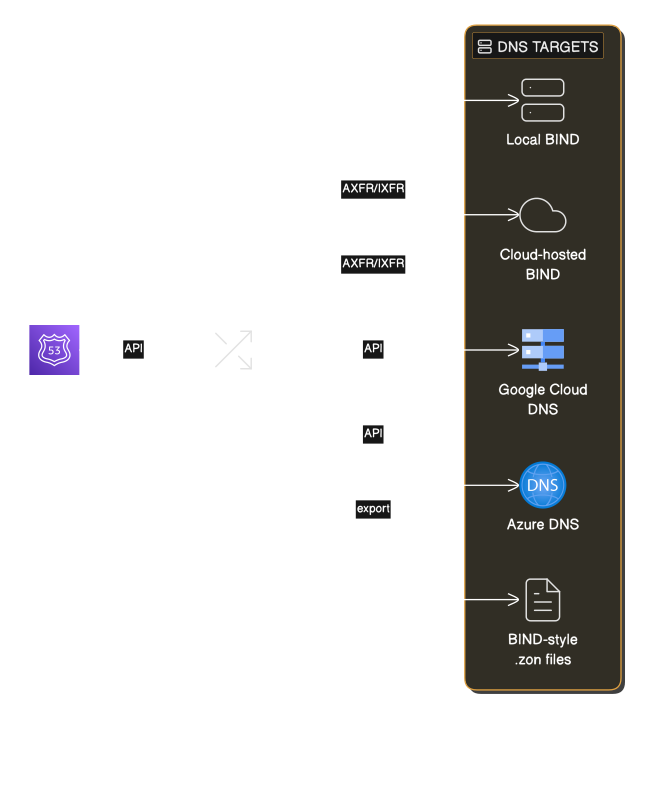
Key characteristics:
- DNS queries continue to resolve directly via Route 53 or other authoritative servers
- No proxying or interception of traffic
- Synchronization of DNS between cloud proivders and BIND based DNS services
This pattern separates DNS state synchronization from DNS query resolution, allowing you to maintain Route 53's reliability while adding standard DNS workflows. Some translators can also optional function as a local hidden primary for redundancy or performance benefits.
Where ZoneMesh Fits#
ZoneMesh is a SaaS implementation of this translation model.
It enables teams to:
- Synchronize Route 53 zones without replacing Route 53
- Feed AXFR / IXFR‑compatible secondaries
- Run synchronization hubs in your own infrastructure (on prem or cloud)
- Avoid custom scripting and fragile exports
ZoneMesh does not sit in the DNS query path and does not cache or rewrite DNS responses, so your DNS traffic stays completely within your private infrastructure.
ZoneMesh provides a managed solution for DNS synchronization without requiring you to build and maintain custom API polling scripts or zone transfer infrastructure.
What This Approach Does Not Do
- It does not turn Route 53 into a traditional AXFR primary
- It does not proxy DNS queries
- It does not require migrating zones into a third‑party resolver
The goal is controlled, standards-based synchronization — not traffic manipulation.
Security Considerations#
The ZoneMesh approach supports strong security practices:
- Hubs run in your environment (BYOC)
- No access to live DNS query traffic
- No cross‑provider credential sharing
- Compatible with TSIG and DNSSEC‑based workflows
This aligns well with regulated and security‑sensitive environments, as all synchronization happens through your own infrastructure.
Summary#
Route 53 is excellent at what it is designed to do — but zone transfers are not part of its model.
By introducing a DNS translator, teams can:
- Export and synchronize Route 53 zones reliably
- Maintain secondary DNS servers
- Support multi‑cloud architectures
- Reduce long‑term DNS lock‑in
ZoneMesh provides one way to implement this pattern while preserving Route 53 as the authoritative source of truth.
Frequently Asked Questions#
Does Route 53 support AXFR?#
No, Amazon Route 53 does not support AXFR (full zone transfers) or IXFR (incremental zone transfers). Route 53 is a managed DNS service that uses APIs for zone management rather than traditional DNS zone transfer protocols. If you need to synchronize Route 53 zones with secondary DNS servers that require AXFR/IXFR, you'll need to use a DNS translator or control plane that reads from the Route 53 API and serves zone transfers to downstream servers.
How do I export Route 53 DNS?#
To export DNS records from Route 53, you have several options:
- AWS CLI: Use
aws route53 list-resource-record-sets --hosted-zone-id YOUR_ZONE_IDto export records in JSON format - AWS Console: Navigate to the hosted zone and manually copy records (not practical for large zones)
- Third-party tools: Use tools like cli53 or dns-tools that can export Route 53 zones to standard BIND zone file format
- DNS synchronization services: Use a service like ZoneMesh that continuously monitors your Route 53 zones and can export or sync them to other DNS providers
For ongoing synchronization rather than one-time exports, a DNS synchronization approach is more reliable than scripted exports that need to be monitored and can potentially drift out of sync.